How to Stop Natural Deodorant From Staining Your Shirts
You switched to natural deodorant for good reasons. Fewer questionable ingredients, no aluminium, an armpit that finally stopped feeling like it was under management. And then you pulled a white shirt out of the wash and found a stiff yellow patch where the fabric used to be soft.
Frustrating, especially when the whole point was to do right by your skin and your stuff. The good news is that natural deodorant staining is almost always a fixable problem, not a permanent one. You just have to know what is actually doing the staining, because it is probably not what you think.
First, a myth worth killing: it is rarely the sweat
Most people blame their sweat. Sweat is the usual suspect, so it gets the rap. But fresh sweat from your underarms is mostly water and salt, and on its own it runs pretty clear.
The yellow you see is a reaction. It is what happens when the compounds in your deodorant, the proteins in your sweat, and sometimes the minerals in your laundry water all meet on the fabric and sit there. Heat from your dryer then bakes the whole thing in. That is why the stain often shows up worse after washing, not before. You are not staining your shirt during the day so much as setting the stain during the laundry.
Worth knowing if you are coming from an antiperspirant: the classic crunchy yellow stain is strongly linked to aluminium reacting with sweat. Natural deodorants skip aluminium entirely, which is one reason people switch in the first place. Our whole range of aluminium-free deodorants is built without it, so if hard yellow antiperspirant stains were your issue, moving away from aluminium already solves a big part of the problem.
The two kinds of marks, and why they are different
People lump all deodorant marks together, but there are really two, and they have different causes and different fixes.
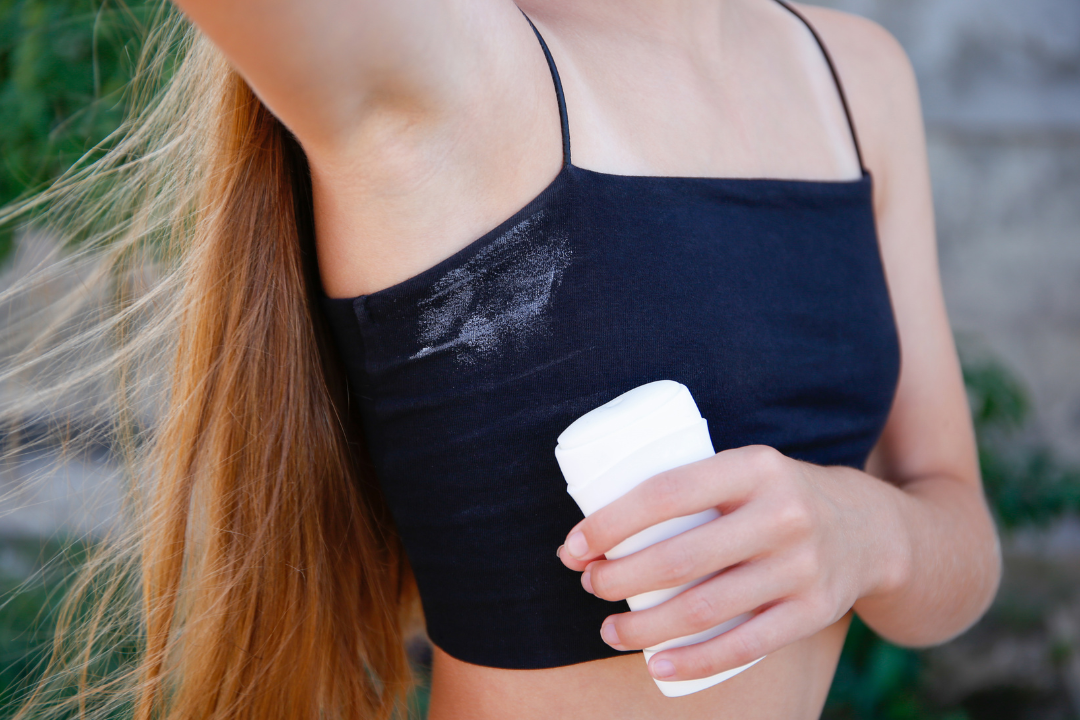
White streaks are the easy one. That chalky transfer on a dark shirt is just product that has not absorbed yet, lifting off onto the fabric as you pull it over your head. It is not a stain in any real sense. It brushes off, and it means you are applying while the balm is still sitting on the surface of your skin.
Yellow or stiff patches are the trickier one. These build up over time as residue accumulates in the fabric fibres, oxidises, and gets locked in by dryer heat. Left long enough they can crust and turn the underarm of a shirt board-stiff. This is the one worth putting a bit of effort into.
Knowing which one you are dealing with saves you from over-treating a white streak that just needed thirty seconds to dry.
Stop the white streaks in one change
Apply less, and wait.
Natural balms are richer than the dry chalk of an antiperspirant, so a little goes a long way and it needs a moment to melt in. Two or three swipes is plenty. Then give it thirty seconds to a minute before you get dressed, the same way you would let sunscreen sink in before pulling on a shirt.
If you are still getting transfer, warm the balm slightly first. A quick press of clean fingertips over the applied area helps it absorb into the skin instead of sitting on top waiting to grab your shirt. Our balms are formulated to sink in rather than sit greasy, but any natural deodorant benefits from those extra few seconds. If white marks are your main complaint, this alone usually ends them.
Stop the yellow build-up before it starts
This is about laundry habits more than anything you do in the bathroom.
Wash sooner rather than later. The longer residue sits in fabric, the more it oxidises and the harder it sets. A shirt worn once and left in the hamper for a week is working against you.
Skip the hot wash for anything you have worn under your arms. Warm or cold water lifts residue without cooking it into the weave. Hot water does the opposite.
Air dry when you can, at least for the shirts you care about. The dryer is where a faint mark becomes a permanent one, because sustained heat is what bakes residue in for good. Line-drying breaks that final step in the chain.
And go easy on fabric softener. It coats fibres and can actually trap deodorant residue rather than release it, which is the opposite of what you want on an underarm seam.
How to treat a stain that already set in
Do not panic and reach for bleach, especially on white cotton, because chlorine bleach can react with protein residue and turn a yellow mark darker.
Start gentle. Make a paste of baking soda and a little water, work it into the stain, and leave it for fifteen to twenty minutes before washing as normal. For tougher patches, white vinegar or a splash of oxygen-based (not chlorine) stain remover does the job without wrecking the fabric. The pattern is always the same: treat, wait, wash warm not hot, then check before it goes near any heat. If a faint shadow remains, repeat before drying rather than after.
For delicate or coloured fabrics, spot-test first. Nothing here is harsh, but silk and wool have opinions.
A quiet note on the ingredients doing the work
Part of why AporeNaturals deodorants are gentler on skin also makes them gentler on fabric. They are baking-soda-free and use magnesium to neutralise odour, alongside witch hazel, arrowroot, chamomile and Centella Asiatica. No aluminium, no synthetic fragrance load, nothing designed to plug your pores. That matters for staining because a lot of what crusts into a shirt over time is the heavier residue that pore-blocking antiperspirants leave behind.
Formulated in Singapore for a climate that runs hot and sticky year round, they are built to hold up in real humidity without needing a thick slab of product to do it. Less product on the skin means less product with any chance of reaching your shirt. If you want the full ingredient breakdown, it is all laid out on our ingredients page. Scents like Lavender and Lime and Eucalyptus and Bergamot keep the fragrance light and skin-friendly, and if you cannot decide, the Mix and Match Trio lets you try a few.
The short version
White streaks mean you got dressed too fast. Apply less and wait a minute. Yellow build-up is a laundry problem more than a deodorant problem, so wash sooner, wash cool, skip the dryer, and go light on softener. Treat set-in marks gently with baking soda or vinegar, never chlorine bleach, and never with heat until the stain is gone. Do those things and your shirts and your armpits can both be happy at the same time, which was the entire point.
Frequently asked questions
Does natural deodorant stain clothes more than antiperspirant? Not usually. The hard, crunchy yellow stain most people picture is closely tied to aluminium reacting with sweat, and natural deodorants have no aluminium. What natural deodorant can leave is white transfer from richer balms, which wipes off, and light residue build-up that is easy to manage with cooler washes and air drying.
Why did my shirt turn yellow only after washing? Because washing, and especially drying, is when the stain sets. Heat oxidises the residue already sitting in the fabric and locks it in. Washing sooner in cool water and skipping the dryer for underarm-worn shirts breaks that chain.
How do I get white deodorant marks off a dark shirt fast? Rub the mark with a clean, dry section of the same fabric, or use a dampened cloth or a dryer sheet. White marks are unabsorbed product sitting on the surface, so they lift off without any real treatment. Next time, apply less and wait a minute before dressing.
Can I still use baking soda on the stain if my deodorant is baking-soda-free? Yes. Baking soda as a laundry pre-treatment sits on the fabric, not your skin, so it will not cause the underarm irritation that baking soda in a deodorant sometimes does. If your skin reacts to baking soda deodorants, that is a separate issue worth reading up on.